Scope note: this guide is written for readers comparing SEO migration, CMS rebuild, content inventory, redirect mapping, analytics continuity, and launch support. It is based on public documentation, provider evidence patterns, and The Internet Consultancy's editorial framework. See our /about/ page for the site remit and /editorial-policy/ for how recommendations are separated from commercial relationships.

Quick decision
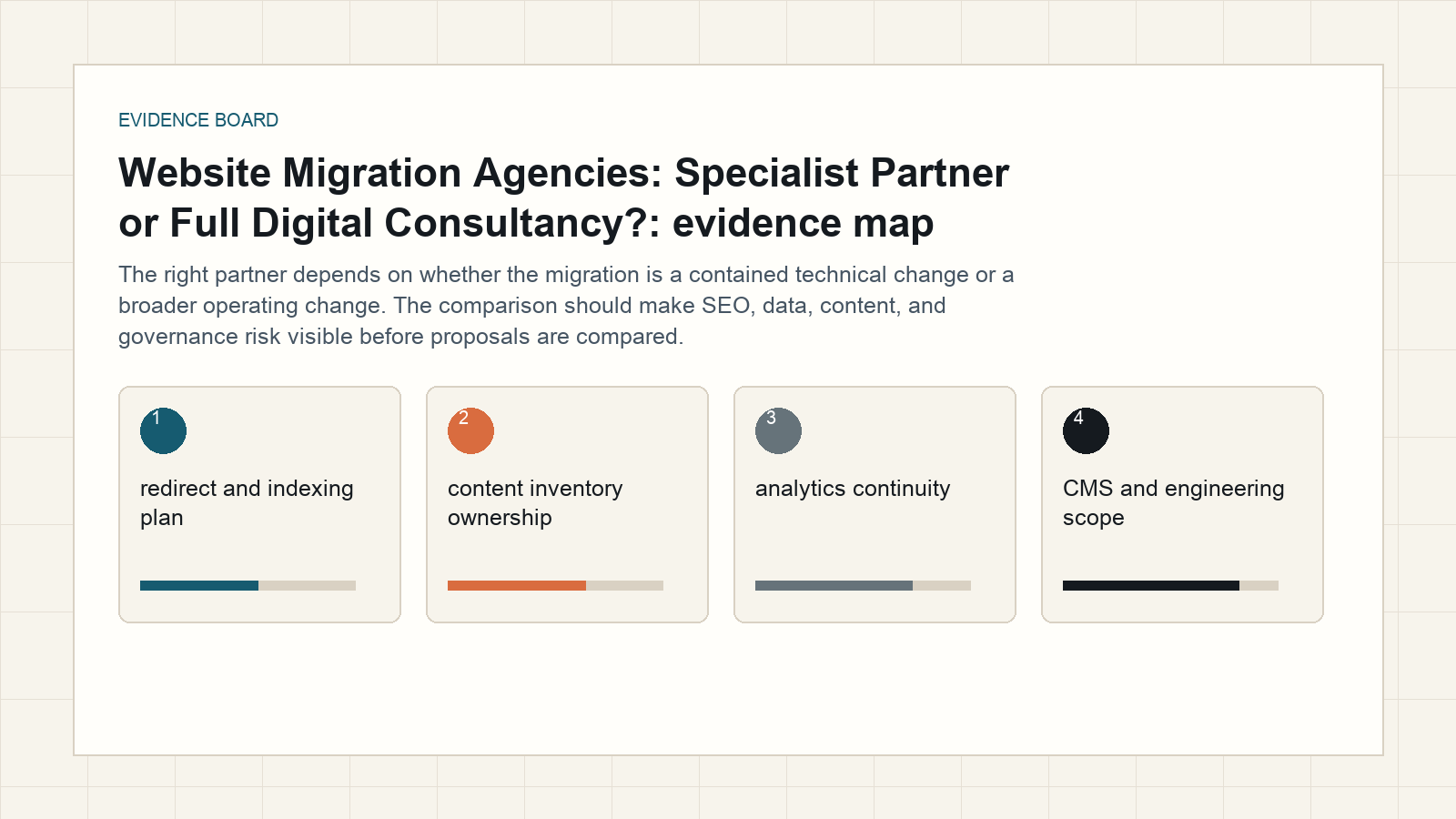
The right partner depends on whether the migration is a contained technical change or a broader operating change. The comparison should make SEO, data, content, and governance risk visible before proposals are compared.
A buyer should begin by writing the operating job in plain language. For website migration agencies, that job usually includes the visible deliverable and the less visible operating assets around it: access, documentation, reporting, decision rights, and support rhythm. Providers can sound similar until those assets are named. Once they are named, the comparison becomes easier and the proposal call becomes more useful.
This matters because a digital services purchase rarely fails only because the visible output was poor. It fails when ownership is unclear, internal teams cannot operate the result, reporting is not trusted, or the provider's commercial model rewards activity that does not match the buyer's risk. Our review order therefore starts with fit and proof before price or promotional offers.
Buyer scenario
A website migration looks like a technical project until the buyer lists everything that can break: search visibility, analytics continuity, forms, CRM handoff, content ownership, page speed, accessibility, paid media landing pages, and stakeholder approval. A specialist migration agency can be the right answer when these risks are known and contained. A broader consultancy fits when the migration is also a rethink of how digital work is owned.
The decision should start with the migration inventory. If the team can name the URLs, content owners, redirect logic, analytics events, CMS model, and launch support needs, a specialist can often move faster. If those items are still unresolved because departments disagree, a broader partner may reduce the governance risk even if the technical work costs more.
| Migration condition | Specialist agency | Full consultancy |
|---|---|---|
| Clear CMS move with known pages | Strong fit | May be heavier than needed |
| Search visibility is the main risk | Strong fit if SEO discipline is proven | Useful only if wider change exists |
| Content ownership is unresolved | Limited fit | Stronger fit |
| Migration tied to operating model | Limited fit | Stronger fit |
Do not let the partner category hide the must-have assets. The buyer still needs redirect ownership, analytics continuity, content sign-off, support after launch, and a clear internal owner for each risk.
What to compare first
Redirect and indexing plan. Ask the provider to show how this appears in real delivery artifacts, not only in a proposal. A useful answer names the inputs required from the buyer, the decision that will be made, the output that will be handed over, and the owner after the engagement. If the answer stays abstract, the buyer has learned that the next call needs more evidence before commercial terms are discussed.
Content inventory ownership. Ask the provider to show how this appears in real delivery artifacts, not only in a proposal. A useful answer names the inputs required from the buyer, the decision that will be made, the output that will be handed over, and the owner after the engagement. If the answer stays abstract, the buyer has learned that the next call needs more evidence before commercial terms are discussed.
Analytics continuity. Ask the provider to show how this appears in real delivery artifacts, not only in a proposal. A useful answer names the inputs required from the buyer, the decision that will be made, the output that will be handed over, and the owner after the engagement. If the answer stays abstract, the buyer has learned that the next call needs more evidence before commercial terms are discussed.
Cms and engineering scope. Ask the provider to show how this appears in real delivery artifacts, not only in a proposal. A useful answer names the inputs required from the buyer, the decision that will be made, the output that will be handed over, and the owner after the engagement. If the answer stays abstract, the buyer has learned that the next call needs more evidence before commercial terms are discussed.
Post-launch monitoring. Ask the provider to show how this appears in real delivery artifacts, not only in a proposal. A useful answer names the inputs required from the buyer, the decision that will be made, the output that will be handed over, and the owner after the engagement. If the answer stays abstract, the buyer has learned that the next call needs more evidence before commercial terms are discussed.
Evidence that deserves weight
Strong evidence has context. A case study should describe the starting constraint, the workstream, the buyer's limitation, and the result. A credential helps only when it supports the specific job. For website migration agencies, evidence should also explain maintenance: what the buyer can operate later, what documentation exists, and what support remains available if the provider is no longer retained.
External standards are useful because they make the conversation less subjective. For example, public digital delivery guidance such as [google site move](https://developers.google.com/search/docs/crawling-indexing/site- move-with-url-changes), [google redirects](https://developers.google.com/search/docs/crawling- indexing/301-redirects), ga4 events gives buyers a way to ask about accessibility of decisions, measurement, governance, privacy, and content quality without accepting a supplier's vocabulary as the only frame.
Buying risks to remove early
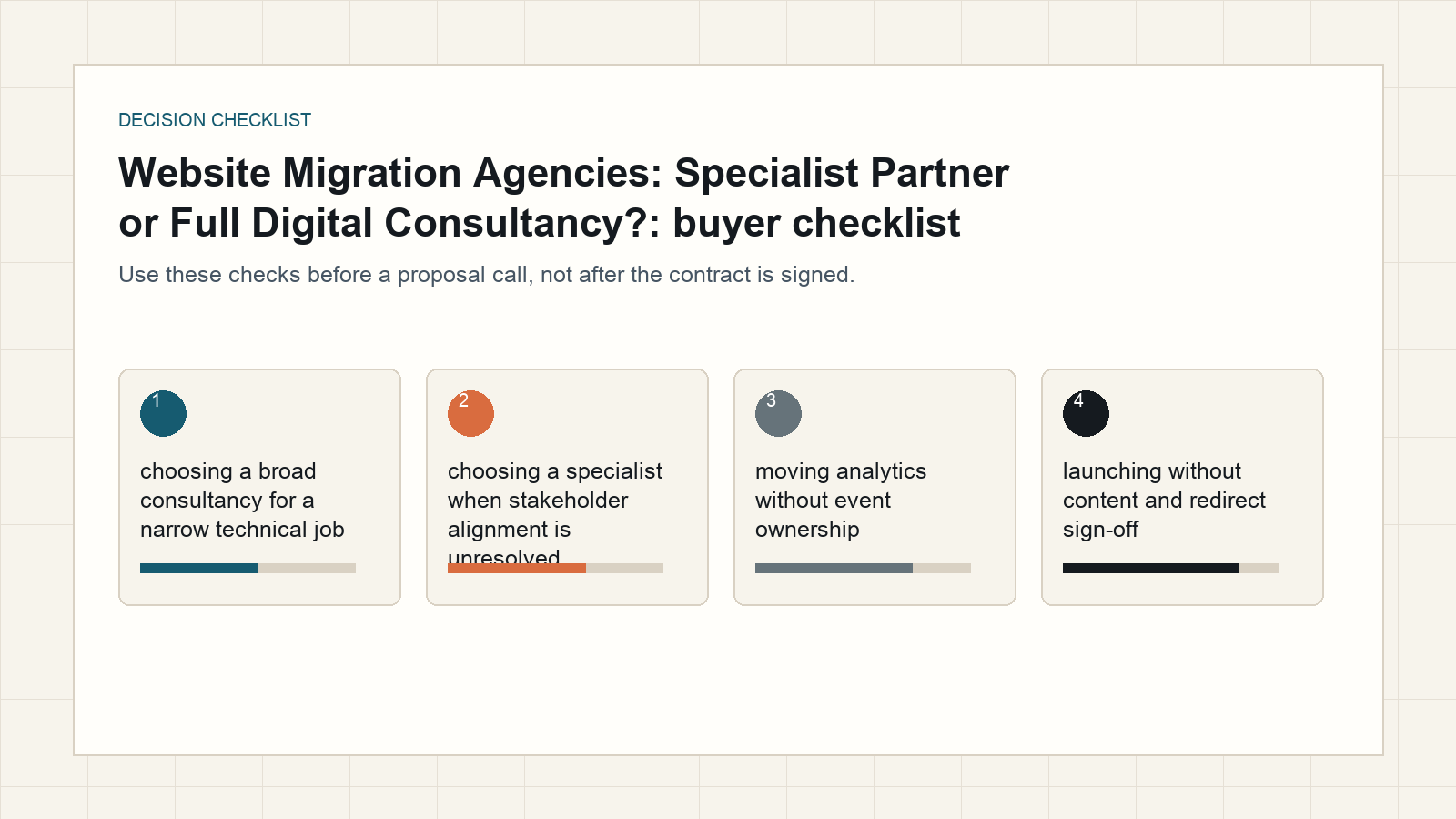
Risk: choosing a broad consultancy for a narrow technical job. Put this into the brief as a question with an expected artifact. A provider should be able to explain how the risk is discovered, who owns it, when it is reviewed, and what happens if it appears late. If the provider treats the issue as an edge case, the buyer should lower confidence until comparable evidence is supplied.
Risk: choosing a specialist when stakeholder alignment is unresolved. Put this into the brief as a question with an expected artifact. A provider should be able to explain how the risk is discovered, who owns it, when it is reviewed, and what happens if it appears late. If the provider treats the issue as an edge case, the buyer should lower confidence until comparable evidence is supplied.
Risk: moving analytics without event ownership. Put this into the brief as a question with an expected artifact. A provider should be able to explain how the risk is discovered, who owns it, when it is reviewed, and what happens if it appears late. If the provider treats the issue as an edge case, the buyer should lower confidence until comparable evidence is supplied.
Risk: launching without content and redirect sign-off. Put this into the brief as a question with an expected artifact. A provider should be able to explain how the risk is discovered, who owns it, when it is reviewed, and what happens if it appears late. If the provider treats the issue as an edge case, the buyer should lower confidence until comparable evidence is supplied.
Proposal questions
Which comparable engagement best matches this operating job, and what constraint made it difficult?
What information, access, and owner time do you need before pricing becomes reliable?
What will the buyer own at the end: accounts, source files, dashboards, research, documentation, and decision records?
How do you report decisions, not just activity?
What support is included after launch or handover, and what requires a separate agreement?
Which part of this brief would you narrow before signing?
How to use the shortlist
Use this page with implementation-partner-shortlist, vendor- evaluation, digital-services, enterprise- transformation. The goal is not to create a universal ranking. The goal is to make a defensible shortlist for a specific job, with every provider compared against the same operating need, evidence standard, ownership model, and support expectation.
For teams that need broader context, start with digital services and then move into the relevant buying lane. For a delivery-heavy change, read implementation partner shortlist. For data and reporting work, use analytics implementation partners. For commercial retainer decisions, compare managed SEO and content operations.
Editorial position
The Internet Consultancy does not treat commercial availability as proof of quality. A discount, referral link, or partner relationship can be useful context, but it cannot replace the evidence above. The best provider for website migration agencies is the one whose model fits the buyer's operating job and whose handover leaves the buyer with more control, not less.
Before signing, ask for the artifacts that would make the recommendation auditable: a scope map, a risk register, an ownership matrix, and a support note. Those documents do not need to be long, but they should make the provider's assumptions visible enough that the buyer can challenge them before money changes hands.
Frequently asked
Is a specialist migration agency enough for a CMS move?
Yes, if the scope is clear, content ownership is stable, and the main risks are redirects, analytics continuity, QA, and launch support.
When is a consultancy worth the extra cost?
A consultancy is easier to justify when migration is part of a wider operating change involving governance, stakeholders, content model, or internal adoption.
What should never be skipped?
Redirect planning, analytics continuity, content inventory, ownership of access, and post-launch monitoring should be explicit before signing.
Final selection notes
A confident decision should read like a short operating memo. It should state why this provider category fits, which evidence carried the most weight, which risks remain, and which internal owner will review the first phase. If the memo cannot be written, the shortlist is not yet ready. That does not mean the provider is weak; it means the buyer has not gathered enough decision-quality evidence.
When two providers look similar, compare the first thirty days. The stronger partner will usually be clearer about discovery, access, decision owners, reporting rhythm, and the point at which assumptions can be changed. That early operating discipline is often more predictive than a polished final presentation.
For website migration agencies, the safest commercial path is a bounded first phase with clear deliverables and review criteria. A buyer can then extend support, add channels, or commit to a longer engagement after evidence accumulates. This keeps momentum without turning uncertainty into a long contract.